← Back to Lisa's Expeditions
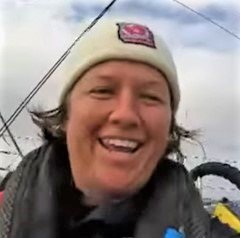
Lisa Blair at the science station on board Climate Action Now, beside the OceanPack seawater sampler
Climate Action Now · Expedition Science 2022

Sailing for science around Antarctica

In 2022 I sailed solo, non-stop and unassisted around Antarctica in 92 days. Every day of that record, I was also working as a citizen scientist: filtering the Southern Ocean for microplastics, launching drifting weather buoys and an Argo float, and sending data to scientists from one of the most remote places on Earth.

Photo: Corinna Ridgeway
178seawater samples collected
83 of 83samples analysed contained plastic
115,600 Lof seawater filtered for the results
8drifter buoys, each named after a sailor
1Argo float, diving to 2,000 m
Explore the data

Every sample, every buoy, on the globe

Press play to sail the voyage again. The track is coloured by how much plastic each 22-hour sample caught, and the longer and redder the spike, the more plastic. Keep it running after I finish and you can watch my drifter buoys drift on around Antarctica for years.

Plastic per 1,000 L:lowhigh (143)
Show on the globe:
Loading the globe…
Seawater filtered0 LPlastic pieces found0
21 Feb 2022
Dive deeper

Pick a science project

Lisa in front of the hull covered in Climate Action Now post-it note pledgesPhoto: Corinna Ridgeway
Climate Action Now

What you can do

I used to bury my head in the sand and tell myself my little bit wouldn't matter. If a million people think that way, that's a million more negative impacts. But if a million people realise their micro-actions matter, together we create a massive impact.

  • Install a filter on your washing machine to catch fibres before they reach the ocean.
  • Buy natural-material clothing where you can.
  • Be mindful of plastic in the streets and waterways, and dispose of your bottles correctly.
  • Drive less: you cut CO₂ and the microplastics worn off tyres.
  • Invest in quality products and repair over replace.
  • Spend wisely: you are voting with your dollar.

We all have the power to create change. It just starts with one action.

Why a sailor collects science

The Southern Ocean is one of the least measured places on the planet

"I am a huge believer that as an adventurer I have a responsibility to our communities to support science. The Southern Ocean is such a data-sparse area of our planet and it would have been almost impossible for scientists to collect the data I was able to generate."Lisa Blair

I was going to be out there for three months anyway, so I turned Climate Action Now into a floating micro lab. My samples went to the Australian Institute of Marine Science (AIMS), supported by IMOS: together they make up the first near-continuous microplastics survey of the Southern Ocean.

MicroplasticsA sampler in the hull filtered seawater 22 hours a day for AIMS and IMOS.
Ocean health micro labLogged sea temperature, salinity, acidity and CO₂ around the clock.
8 weather drifting buoysLaunched for the Bureau of Meteorology to improve forecasts.
1 Argo floatDeployed for CSIRO. It dives to 2,000 m every 10 days.
Mobile weather stationHourly air pressure sent to forecasters in real time.
Seabed 2030 & OceanOPSSeafloor depth data, and part of the UN Ocean Decade's Odyssey program.
Science partners

Thank you to the scientists who made this possible

Australian Institute of Marine Science (AIMS) Integrated Marine Observing System (IMOS) Bureau of Meteorology Seabed 2030 OceanOPS

Microplastics data: Santana, M.F.M., Blair, L., Vickers, K., Miller, M. and Motti, C.A. (2023), Circumnavigation of Antarctica Reveals Microplastic Contamination in the Southern Ocean, Australian Institute of Marine Science, supported by IMOS. Results are summarised here in Lisa's words, and the charts are drawn from the report's sample table.

Lab video: Australian Institute of Marine Science (AIMS). Bottle cap video: Australian National Maritime Museum. Weather buoy tracks: NOAA Global Drifter Program. Argo float data: Argo program via Ifremer (float 5905498). Photos: Corinna Ridgeway (where credited) and Lisa Blair on board.