Two boats. One mission.
The yacht that carried Lisa to eight world records, and the eco-engineered yacht being built for the Arctic.
Climate Action Now
"Choosing the right boat for a challenge like mine is so important. The first time I laid eyes on Climate Action Now, then known as Funnel-Web, I was in love. She is a safe, strong and seaworthy vessel that can really go anywhere and do anything." Lisa Blair
Her history
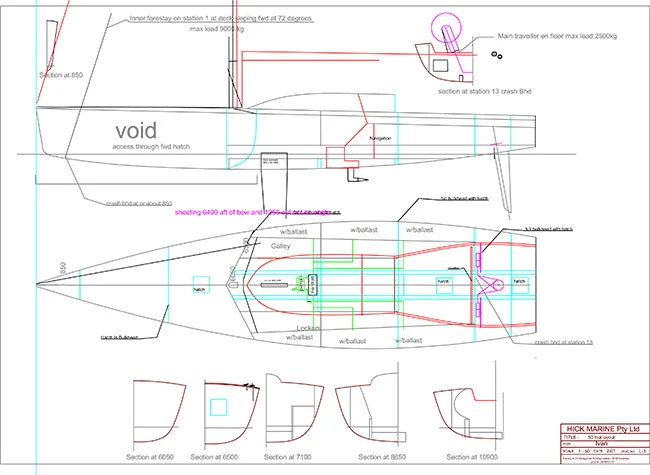
Originally named Funnel-Web, she was commissioned by Ivan and Sibby McFadyen for the 2003 Melbourne to Osaka Yacht Race, finishing third over the line. She raced the 2004 Rolex Sydney to Hobart, finishing 48th in a year when 57 boats retired, then the 2013 Melbourne to Osaka and the 2013 Transpac to Honolulu.
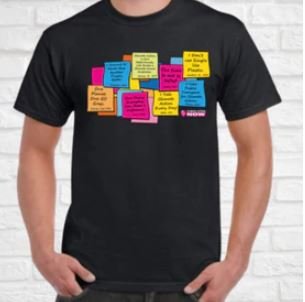
Lisa bought her in September 2015, renamed her Climate Action Now on the day entries closed for the Rolex Sydney to Hobart, and raced her that December with a crew of seven. Together they have sailed solo around Antarctica twice, around Australia and around New Zealand, and set the record from Sydney to Auckland, wrapped in thousands of handwritten climate pledges.
A statement of eco-conscious exploration
Lisa refits her meticulously before every major voyage, and has fitted wind generators, solar panels and biodiesel to make her expeditions 100% eco-powered.
Lisa's expeditions The sticky-note movementThe numbers
| Designer | Robert Hick |
| Builder | Hick |
| Material | Fibreglass / GRP, balsa cored |
| Length | 15.25 m |
| Beam | 3.9 m |
| Draft | 3.44 m |
| Year | 2003 |
| Weight | 11 tonnes |
| Water ballast | 6 tanks, 1,902 kg per side |
| Rigging | Aluminium fractional sloop |
| Limit of positive stability | 129.5° |
The Arctic yacht
To complete the Arctic Impact Project, Lisa is building a custom, eco-engineered yacht, purpose-built for speed, resilience and sustainability, and designed to sail the Arctic Circle solo, non-stop and unassisted.
- Built from basalt fibre, a natural volcanic-rock fibre, instead of fibreglass
- Paired with bio-resins, working towards a fully recyclable hull
- 100% renewable power: solar, wind and biodiesel
- Designed for strength-to-weight performance in extreme polar conditions
- A proof of concept for the future of circular marine construction
The materials are being tested in a two-year research partnership with UNSW Sydney, ACM CRC, Steber International and SOENECS, including a 15-foot test hull built by Steber.

Digital mock-up. The final design is being engineered now.
The innovation behind it Arctic sponsors & partnersNext: the Arctic
In June 2028 Lisa sets out to become the first person to sail solo, non-stop and unassisted around the Arctic Circle.
The Arctic Impact Project Become a 360° Partner